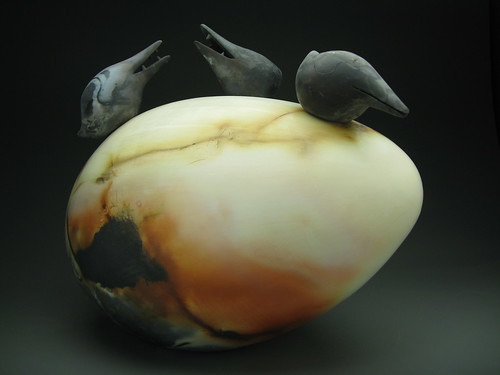
One of my pieces, Cuckoos #3: Unexpected Twist, just finished being displayed in the 3rd Biennial Concordia Continental Ceramics Competition in St. Paul, MN. I’d been stressing about the piece being shipped back, since it’s both large and delicate. When I got a call on Monday from the organizer, I immediately started worrying, only to be utterly surprised. The piece had been stolen.
While the gallery was open for local artists to pick up their work, someone had walked in and left with four piece that did not belong to them. The university didn’t realize the problem until they were preparing to pack up the out-of-town pieces. A vase by Leopold Foulem, a wonderful teapot-ish sculpture by Gerald Ferrari, and a piece by Kevin Snipes were also taken. (Gerald has a very insightful blog post about the theft.) The total listed value for the work was over $12,000, most of that was due to Foulem’s vase. All the same, a life of crime stealing ceramics sculptures is hardly a way to get rich quick. Heck, if there’s a way to get rich in ceramics, there’s lots of ceramics artists who’d love to know about it.
Overall, my response has mostly been confusion. I am a bit worried about my piece, as to whether or not its safe. My biggest fear if that some scofflaws just grabbed it on a whim, and it’s been trashed somewhere. That would break my heart. The university has said that they’ll deal with the insurance, so at least I’m not worrying about that. They could have handled the show taken down better, but no sense in being angry about that – they didn’t want this to happen either. I guess it’s a bit flattering that someone likes the piece so much, but really, it would have been better to for them to just buy it. It’s been so weird seeing pictures of it on the local news, and having my relatives emailing each other about it. Add to all that, it’s not a small piece! It’s large enough it needs to be carried in both arms, and the surface is delicate enough that it could be scratched by snaps or zippers. While I guess do feel strangely honored to be on a list that includes everyone from Miro and Van Gogh to the other 3 artists from this show, I would really rather people just didn’t do stuff like this. It’s so disrespectful to the artists, the work, and the institution that it’s hard for me to wrap my mind around it.
A while ago, my husband and I teamed up to collaborate on some sculptures. He’s a software developer by occupation, and we both appreciate the interesting world where tech and art overlap. We decided to work together, and have slowly been developing a series of glowing sculptures. While it’s been a while since we finished the last one, we decided it would be fun to talk about some process, and share some of the programing and tech behind them.
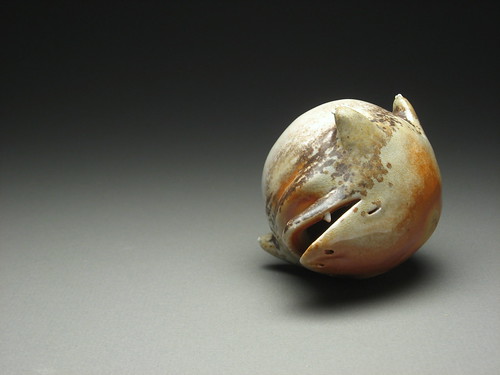
Ever since I saw some translucent porcelain lamps made by Terry Inokuma, I’ve wanted to make a glowing creature. The ultra white porcelain (Southern Ice) I use for teeth in my sculptures also has the property of being amazingly translucent, something I don’t normally pay attention to in a clay. However, a couple years ago I decided to see what I could do with it. The first creature I made to explore the idea of glowing creatures was Glowbelly, a little round fat beast, whose belly reminds me of a pale frog. I used a mix of southern ice and my typical clay to make its belly, making it both paler and theoretically translucent. However, we’ve never been able to find out for sure. As soon as got the beast out of the kiln, it became clear that there were some aspects of electronic beasts that I’d neglected to take into consideration. Namely, the ability to put wires into the beast, the ability to block excess light and direct the LEDS, and the all important on and off switch. While I had a loose idea of just sliding all the electronics in through the mouth, it became clear that much more planning would be required for glowing creatures.
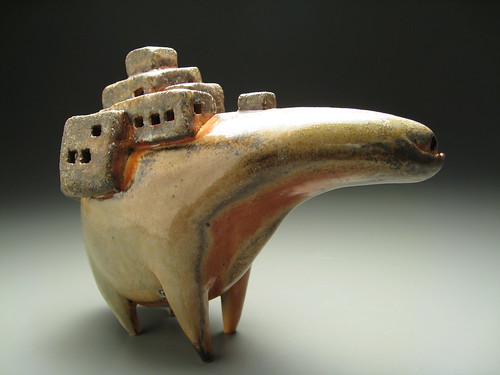
The next step on our experimentation was the Industrial City Beast. By planning ahead, we were able to set up easy access to power switches and wiring. The wiring of the beast was very simple, just a battery, a few LEDs and a resistor or two. (We started playing with the more complex wiring and microcontrollers later). However, we discovered how important the quality of the light was. The beast was to have glowing red eyes, but with the LED just in there, it was as empathetic as a laser pointer. We experimented with a number of materials as diffusers, to give the beast a warmer glow. In the end, we discovered shapelock plastic. This semitranslucent plastic can be heated in boiling water and will become malleable, but hardens on cooling. The stuff is great! It’s designed for rapid prototyping, and it can be reused indefinitely and machine tooled as well as hand formed. It solved two problems at once by both securing and diffusing the red LEDs in the neck of the beast. The white LEDs for the city were reflected internally by covering all internal surfaces with tinfoil, which helped make the light less directional.
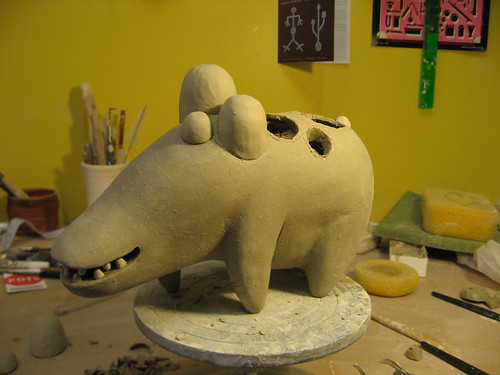
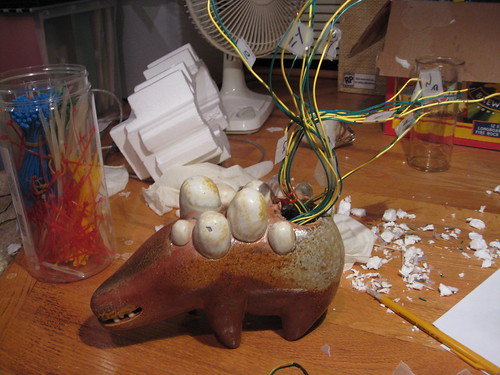
However, the present pinnacle of our collaboration together is the Glowback. We finished it up last year, but got distracted before writing about the process of making it. However, the process is still fascinating, and the result is one of our favorite pieces.
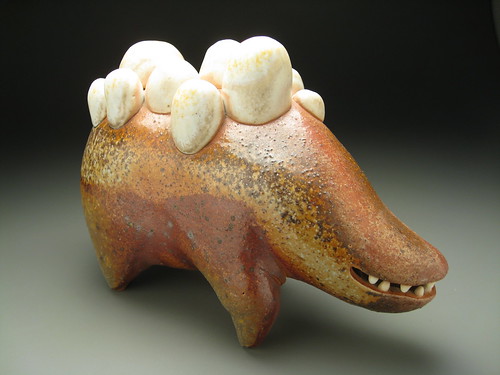
Like many of my woodfire pieces, the beast is a mix of different clays. I used a mix of porcelain and stoneware for its body, southern ice porcelain for its teeth, and a mix of southern ice porcelain and B-mix porcelainious stoneware for the pods on the back. This was so the body with have some grit and texture, the teeth would be white, and the pods would be pale and translucent from the southern ice, but still have some color and crystallization due to the B-mix. Since the beast isn’t very large, about 6″ long, the difference in shrink rates between the clays didn’t cause too many problems. (Porcelain shrinks about 14% from start to finish, while stoneware will only shrink 10%. If there’s long connected seams, the difference in shrink rate can cause the piece to crack.)
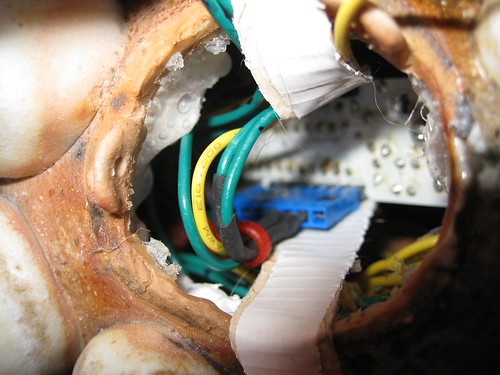
Each bulb on the back of the beast contains a super bright LED mounted in a styrofoam plug, which in turn is secured within the beast. Two of the bulbs were removable, which while seeming adequate during construction, turned the wiring process into a laparoscopic surgery. However after much swearing and and many minor burns from hot glue, all the LEDs were in place.
There’s 11 LEDs in all, and they’re controlled by an arduino microcontroller. (I can’t recommend arduino enough if you’re thinking about getting into this sort of thing.) We programed them to fade in and out in a vaguely hypnotizing pattern. Since the arduino only has enough pins to control 6 things independently, the five largest bulbs pulse independently on random timers, while the six small bulbs pulse all at once. Figuring out the correct rate of fade involved some very interesting math. Here’ssomevideos of the different patterns we tried. My husband Ben’s blog post goes into greater depth about the programing and wiring.
Eventually, once all LEDs were in place, the arduino (we used a smaller arduino clone called a boarduino), was wrestled into place inside of the beast. This ended up being the most difficult part of the process – I’d underestimated the amount of working room needed, and the amount of room the wires would take up. In fact, lack of internal space, and the access to it was in generally the most challenging aspect of the sculpture. Even the thickness of the wires factored into the difficulty – they keep popping off the dome that covers the power switch!
However, the end result is pretty awesome. We had a huge amount of fun constructing it, and I believe it’s lived up to our expectations. Since it’s a fairly experimental beast, it isn’t for sale. Here’s a final documentary video showing off the final completed beast.
This last woodfiring turned out great. Every single piece I got from it was a jewel – an outcome practically unheard of in woodfiring. I normally have at least few pieces I’m not happy with, and people having success rates under 50% is not unheard of. However, as I said, this firing was just amazing. I’ve put all the pieces up into a flickr set, for people browse and enjoy.
Here’s the gallery of all the new work. Most of the pieces are presently on display at the Island Gallery on Bainbridge Island, and they’re also for sale in their online store!
Also, it’s time again my studio’s annual holiday sale. We’ll have an opening party this Friday, December 11th from 6 to 9pm. On Saturday and Sunday from 10 to 4pm, we’ll be around the studio if you want to come in and browse through all the work for sale from myself and my studiomates! The address of the studio is 218 Florentia st, and here’s the facebook invite for more info! Also, during the opening, I’ll be having a silent action of “Relaxation”, with all proceeds going to charity!
I just finished up the timelapse video I made of the creation of one of my saggar fired pieces. I recorded the creation of “Cuckoos #2: Nest”. It tracks the piece from the start to the bisque firing. I particularity enjoy being able to see the process of burnishing the nest. The video is on vimeo since it was just a hair too long for Youtube.
As folks who have been following my twitter might have guessed, I’m about to head out for a woodfiring! I’ve just finished packing up several months worth of critters, who will loaded into the kiln this Saturday and Sunday. They’ll be unloaded in two weeks on Saturday, November 28th.
Most of these guys will then be going directly to the Island Gallery on Bainbridge Island, for their December show, “Beauty and the Beasts”. I’ll be featured along side their annual fashion show. Some will be coming to my studio’s annual holiday sale and party. Stay tuned to my twitter for updates on the firing!